
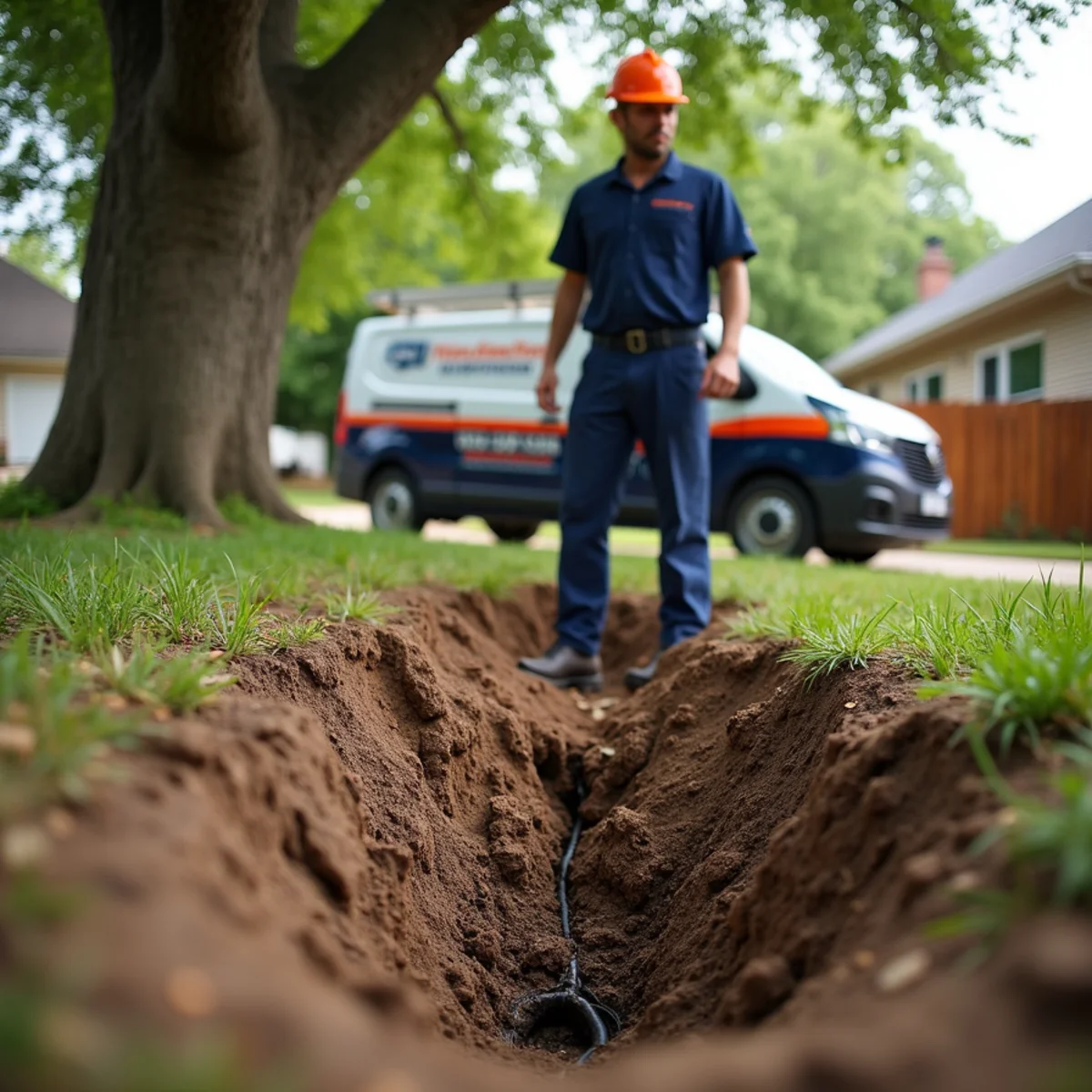
The established neighborhoods of Allen and Plano have something the newer subdivisions don't: big, mature trees lining the streets and shading the yards. They're one of the best things about those areas. They're also the number-one enemy of the sewer lines running under them.
Tree roots seeking water are relentless, and an older clay sewer pipe with a hairline crack at a joint is exactly what they're looking for. If your home was built before the mid-1980s or so, there's a real chance you have both the older pipe and the mature trees — the perfect combination for root intrusion. Here's how it happens and what to do.
Why roots target sewer lines
Roots grow toward moisture and nutrients, and a sewer line is full of both. In hot North Texas summers, the soil dries out but the sewer line stays damp, so roots home in on it. They can't break into a sound, sealed pipe — but they don't have to. They find the tiny gaps: a slightly loose joint, a hairline crack, a spot where the ground shifted.
A root as thin as a hair slips through that gap, reaches the water and nutrients inside, and explodes into a dense mat. Once it's in, it keeps growing, catching grease, paper, and debris until the line clogs. Every backup makes the crack a little bigger, and the cycle accelerates.
The clay pipe factor in older Allen and Plano homes
Homes built in Allen and Plano through the 1960s, 70s, and early 80s were commonly plumbed with vitrified clay sewer pipe, laid in short sections with mortar joints. Clay is durable in some ways, but those joints are its weakness — over decades they crack, shift with the expansive Blackland Prairie clay soil, and open just enough to let roots in.
Add our region's soil movement — the same swelling and shrinking clay that causes slab leaks — and those old joints get worked loose season after season. It's why root intrusion is so common in the established parts of central Plano and older Allen, and much rarer in the newer PVC-plumbed subdivisions to the north.
The warning signs
- Gurgling sounds from toilets or drains, especially when you run water elsewhere
- Multiple drains slowing down at once — a whole-house pattern, not one fixture
- Recurring clogs that come back weeks after you clear them
- Sewage odors in the yard or near floor drains
- Water backing up in a tub or shower when you flush or run the washing machine
- Unusually green, fast-growing patches of grass over the sewer line's path
The recurring nature is the giveaway. A one-time clog is usually a fixture issue. A clog that keeps coming back every few weeks in the same spot is very often roots regrowing after each clearing.
Diagnosis: put a camera in the line
Guessing about a sewer line wastes money. A camera inspection settles it. We feed a waterproof camera down the line and watch on a monitor exactly what's happening — how much root is in there, whether the pipe is cracked, offset, or bellied, and precisely where along the run the trouble sits.
That last part matters for cost. Knowing the roots are 30 feet out, at one specific joint, turns a vague 'the sewer's bad' into a targeted plan. The camera tells us whether you need a cleaning, a spot repair, or a longer replacement — and it's the difference between an honest quote and a guess.
Your repair options, cheapest to most involved
Mechanical clearing and hydro jetting
A rooter cable cuts the roots out, and hydro jetting — high-pressure water — scours the line clean, including the finer roots a cable leaves behind. This restores flow but doesn't fix the crack the roots came through, so on old clay it's a management step, often paired with periodic maintenance.
Spot repair
If the camera shows one bad section, we can dig to that spot and replace just that length of pipe, sealing out the roots for good at that joint. Ideal when the rest of the line is sound.
Line replacement
When the old clay is cracked and root-infested along much of its length, replacing the run — traditionally or with trenchless methods where the layout allows — is the permanent fix. In DFW, sewer repair and replacement generally ranges from a few thousand dollars for a spot repair up into the higher five figures for a full replacement, depending on length, depth, and access. The camera is what tells us which end of that range you're looking at.
Frequently asked questions
Root-killing foams containing copper sulfate can slow regrowth as a maintenance aid, but they won't clear an established root mass or repair the crack the roots entered through. They're a supplement to professional clearing, not a substitute. And never pour caustic drain cleaner into a fully blocked line — it doesn't move roots and it makes the line hazardous to service.
McKinney Pro Plumbers
Licensed McKinney plumbers serving Collin County and North Texas. Work performed under a Texas Responsible Master Plumber (TSBPE). Questions? Call (831) 290-4327.