
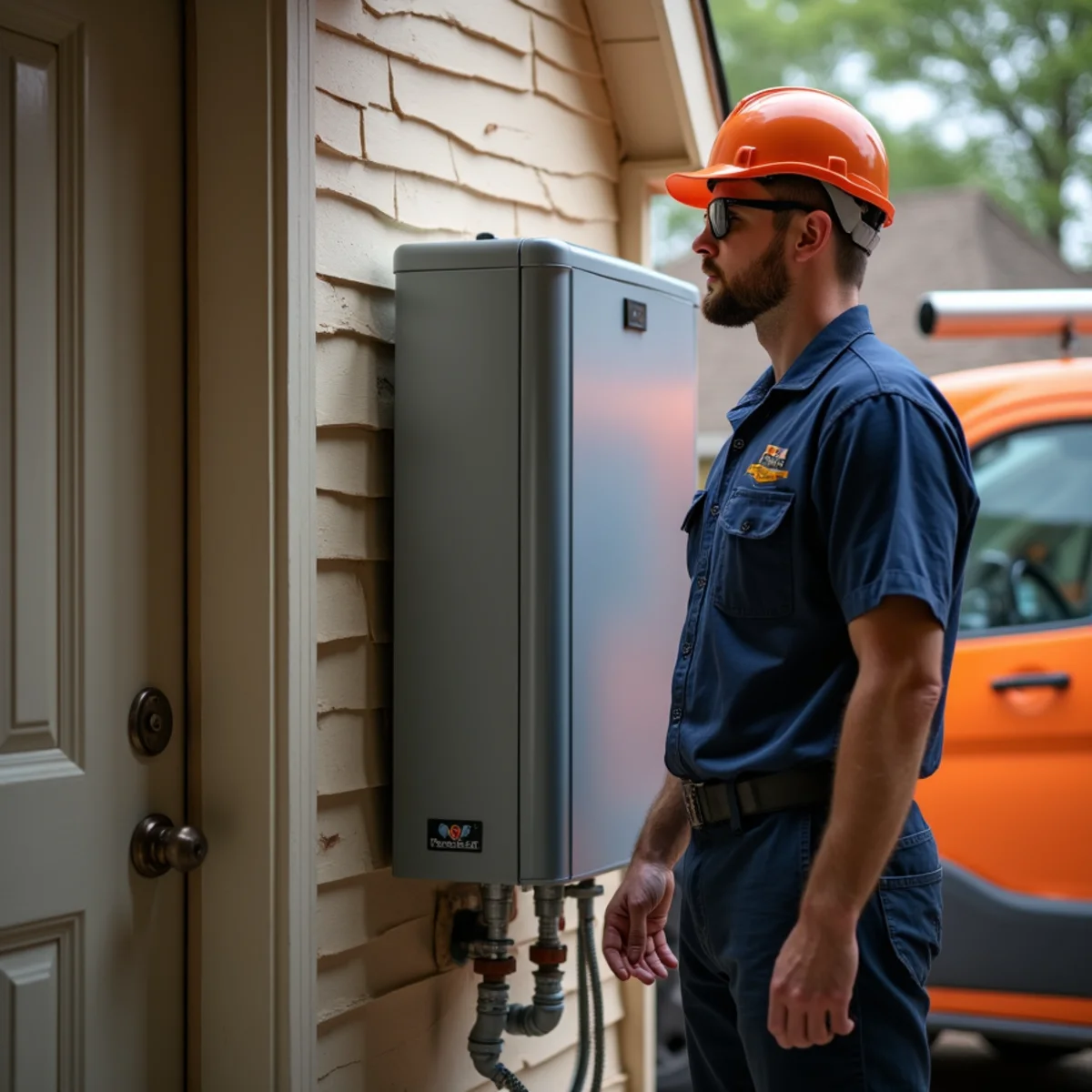
When a McKinney homeowner’s water heater dies, the first question is usually whether to go tankless. The marketing is compelling — endless hot water, lower energy bills, a unit that lasts twice as long and hangs on the wall instead of hogging a closet. Much of that is true. But it comes with a local asterisk, and that asterisk is our water.
McKinney runs on hard water from the North Texas Municipal Water District, loaded with the calcium and magnesium that scale up heating equipment. Hard water is tough on both kinds of water heater, but it is tougher on tankless in a specific way that changes the math. The right choice depends on how you weigh upfront cost, long-term savings, your household’s hot-water habits, and whether you are willing to treat the water.
Here is a straight comparison to help you decide, from plumbers who install and repair both across Collin County.
How each type works
A traditional tank water heater keeps 40 to 50-plus gallons hot and ready around the clock, reheating as the water cools. Simple, proven, and cheaper to buy and install. The tradeoff is standby energy loss — it spends fuel keeping water hot even when no one is using it — and a finite tank of hot water that can run out during back-to-back showers.
A tankless (on-demand) unit heats water only as it flows, using a powerful burner or element and a heat exchanger. No standby loss, endless hot water as long as you do not exceed its flow rate, a smaller footprint, and a longer lifespan. The tradeoffs are a higher upfront cost, a flow-rate ceiling that can strain during simultaneous demand, and — the key one here — greater sensitivity to hard-water scale.
The hard-water factor, honestly
This is where a McKinney decision differs from the same decision in a soft-water city. Hard water deposits mineral scale on any hot surface. In a tank, that scale settles as sediment on the bottom, which is why we recommend flushing tanks here every 6 to 12 months. It shortens the tank’s life, but the unit tolerates a fair amount of it before failing.
A tankless unit is less forgiving. Its heat exchanger has narrow passages, and scale builds up directly on the surface that transfers heat. As it accumulates, efficiency drops, the unit works harder, error codes appear, and eventually the exchanger — the expensive heart of the system — can fail. To stay healthy on hard water, a tankless unit needs to be descaled every 6 to 12 months, and many manufacturers make that maintenance a condition of the warranty.
Cost and lifespan compared
Upfront cost
Replacing a tank water heater across DFW commonly runs $1,200 to $2,500. A tankless replacement typically runs $2,000 to $3,500, and can be higher if the switch requires gas-line upsizing, new venting, or electrical work — retrofitting a tankless into a home built for a tank is where the surprises live. An on-site assessment sets the real number.
Operating cost
Tankless units are generally more energy-efficient because they eliminate standby loss, so they usually cost less to run month to month. How much you save depends on your usage — the savings are larger for households that use less hot water, and smaller for high-demand homes.
Lifespan
A well-maintained tank lasts roughly 8 to 12 years; a tankless unit can last 20 or more. But that longer life is conditional on maintenance. On hard water, a neglected tankless will not reach its potential, and a diligently flushed tank will beat a neglected one. Maintenance, not just the technology, decides the outcome.
Which should you choose?
There is no universal winner. Match the choice to your household and your willingness to maintain it.
- Lean tankless if: you want long-term energy savings and endless hot water, you plan to stay in the home for years to earn back the higher upfront cost, and you will either install a water softener or commit to regular descaling.
- Lean tank if: upfront cost is the priority, you want the simplest and most familiar system, your household’s peak demand is high, or you are not going to keep up with descaling maintenance.
- Either way, add a water softener. On NTMWD water it is the best single upgrade you can make — it protects a tankless heat exchanger, cuts sediment in a tank, and extends the life of every fixture and appliance in the house.
Frequently asked questions
It can be, but only with maintenance. Hard NTMWD water scales a tankless heat exchanger, so the unit needs descaling every 6 to 12 months, and many warranties require it. Paired with a water softener, tankless performs well here. Without either, it will underperform and may fail early.
McKinney Pro Plumbers
Licensed McKinney plumbers serving Collin County and North Texas. Work performed under a Texas Responsible Master Plumber (TSBPE). Questions? Call (831) 290-4327.