
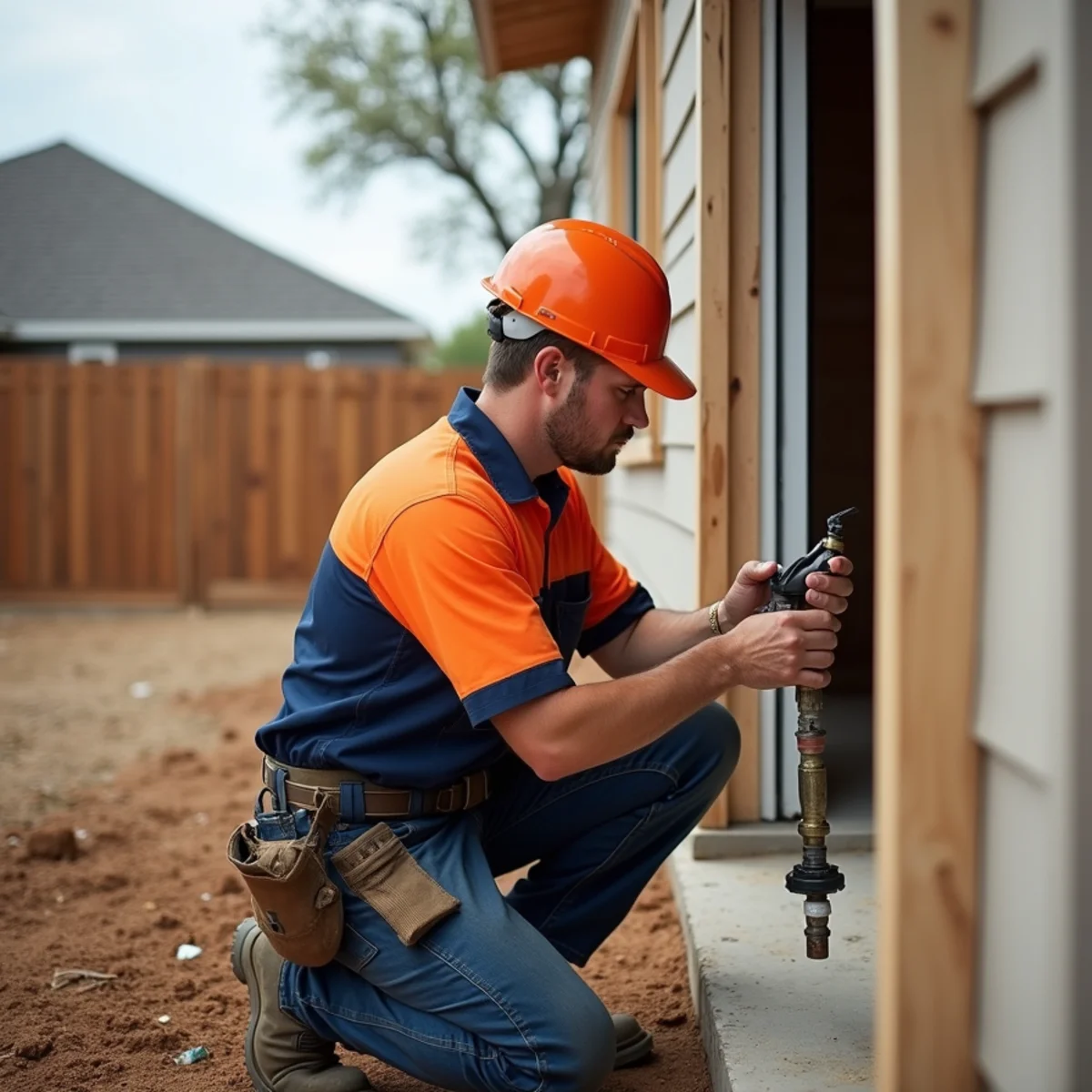
Princeton, Celina, and Anna are three of the fastest-growing cities in the country right now, and the pace shows. Whole subdivisions go up in a season, framing crews and plumbers rotate through dozens of nearly identical floor plans, and the drywall closes up fast. A new house feels like the one thing you should not have to worry about — but the volume and speed that make these builds affordable also make small plumbing shortcuts easy to miss.
A builder’s municipal inspection confirms the home meets code. It does not confirm the work was done well, that fittings were torqued, or that the water heater was set up the way the manufacturer wants. Those are two different bars. A third-party plumbing inspection — one you hire, working for you and not the builder — sits between the final walkthrough and closing, and it is one of the cheapest pieces of insurance you can buy on a six-figure purchase.
Here is what we look for on a new build in Collin County, and why it matters even when everything is under warranty.
A code pass is not a quality pass
Municipal plumbing inspectors are checking that the rough-in and finished work meet the minimum standard set by code. They are stretched across a lot of houses, they look at what is visible on the day they show up, and they are not there to tell you whether the builder chose good fixtures or installed them carefully. Passing inspection means the house is legal to occupy. It does not mean nothing will leak in year two.
The gap between "meets code" and "built right" is where most new-construction plumbing complaints live. Loose supply connections, a water heater with the temperature run high, drains that were glued in a hurry, a slab penetration that was not sleeved correctly — none of these necessarily fail a code check, and all of them can turn into a service call once you have moved in.
What we check on a new build
A pre-closing inspection is non-invasive — we are not opening walls. We run the system the way you will, watch how it behaves, and use a camera and pressure readings to see what the finish work hides.
- Water pressure at multiple fixtures — new builds sometimes ship without a working pressure-reducing valve, and NTMWD supply pressure can run high enough to stress fittings and appliances.
- The water heater install: temperature setting, expansion tank, T&P discharge routing, drip pan and drain, and whether the flue or venting is correct.
- Every fixture run at once and individually — checking for slow drains, gurgling, and traps that were not primed.
- Under-sink and behind-toilet supply connections for drips, cross-threading, and loose compression nuts.
- A sewer-camera pass on the main line to catch construction debris, a belly in the pipe, or a joint that was not fully seated before the yard was backfilled.
- Shut-off valves at each fixture and the main — that they exist, turn, and actually stop the water.
- Hose bibs, the gas line and any gas appliance connections, and the cleanout locations.
The sewer-camera run is the one homeowners skip and later wish they had not. Once the trench is backfilled and sodded over, a dropped fitting or a low spot in the line is invisible until it starts backing up. Catching it while the builder still owns the warranty saves you a dig at your own expense.
Builder-grade defects we see most
High water pressure with no PRV
When incoming pressure runs above roughly 80 psi, it shortens the life of everything downstream — the water heater, washing-machine hoses, ice-maker lines, and fixture cartridges. A pressure-reducing valve is a small part, but plenty of production homes either lack one or ship with it set wrong. A five-minute gauge reading tells us.
Water heater set-and-forget mistakes
We regularly find new water heaters with the thermostat run hot, a missing or undersized thermal expansion tank, or a T&P relief valve piped somewhere it should not discharge. On our hard NTMWD water, a unit that starts life running hot also scales faster.
Drain and vent shortcuts
Slow tubs, a toilet that glugs when the washer drains, and sewer odor at a rarely used fixture usually trace back to venting or trap issues from the rough-in. They are annoying, they are the builder’s responsibility, and they are far easier to get fixed while you still hold leverage before closing.
Timing it around your closing
Schedule the plumbing inspection after the builder’s final walkthrough but before you sign. That puts a written list of findings in your hands while the builder is still motivated to fix things and while the workmanship is squarely inside their warranty window. Bring the report to your walkthrough and ask for the items in writing on the punch list.
We cover new construction across Collin County, including the growth corridors in Princeton, Celina, and Anna, and we are usually anywhere in the county within about an hour. If you are closing soon and want a second set of eyes on the plumbing, call (831) 290-4327 and we will work around your builder’s schedule.
Frequently asked questions
The city inspection confirms code compliance, not workmanship or fixture quality. A third-party inspection works for you and catches the loose connections, pressure problems, and buried-line defects a code pass is not designed to flag. On a new home purchase, it is inexpensive insurance.
McKinney Pro Plumbers
Licensed McKinney plumbers serving Collin County and North Texas. Work performed under a Texas Responsible Master Plumber (TSBPE). Questions? Call (831) 290-4327.